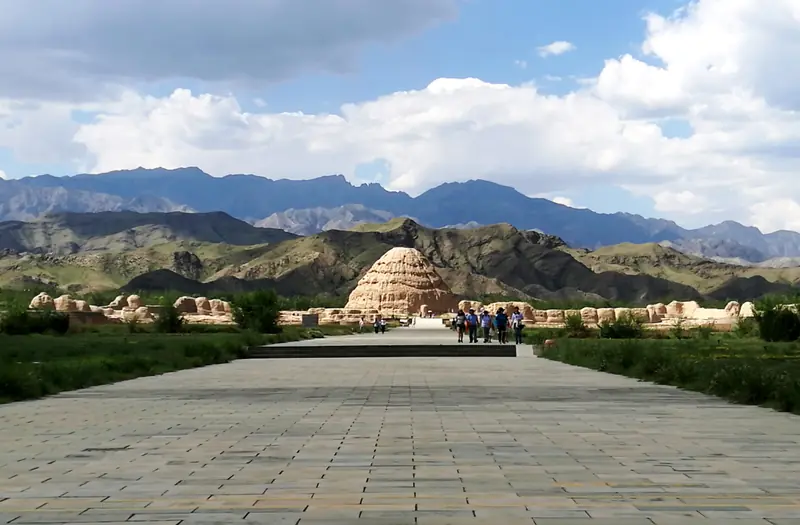
Western Xia Imperial Tombs: Yinchuan Visitor's Guide
Guide to Yinchuan's Western Xia Imperial Tombs — Tangut 'Oriental Pyramids' at Helan Mountain, Xixia Museum, Tomb No. 3, tickets, shuttle, and day-trip combos with rock art.
~13 min readUpdated Mar 2026
🏜️ Tangut Tombs in Gobi
🌍 UNESCO Listed 2025
📜 Lost Script & Museum
🎟️ Mon/Wed Free Gate (2026)
Hours & tickets
Ticket office8:00 – 17:00/17:30
Museum8:00 – 18:00/19:00
~¥60 entrance
+¥5–20 shuttle
60+ free · Students half price · Longer hours in peak season (Apr–Oct)
Good to know
🚌
~25 km west of downtown. Bus 游1 from Xinyue Square (新月广场) or taxi/ride-hail ~¥50–80 one way.
🕐
Half-day minimum. Museum + shuttle + Tomb No. 3 loop. Visit mornings or late afternoon in warm months.
☀️
Near-zero shade outside the museum. Sun hat, sunscreen, 2 L water, closed shoes on gravel.
🗣️
Little English on site. Bring a translation app; save key phrases offline.
Twenty-five kilometers west of downtown Yinchuan, nine ochre cones sit on the Gobi at the foot of Helan Mountain (贺兰山) — the Western Xia Imperial Tombs (西夏王陵), the royal cemetery of a dynasty Genghis Khan's armies erased so thoroughly that most foreign travelers have never heard its name. Eight centuries of wind stripped away glazed tile and timber; what remains are rammed-earth spires on the horizon, nicknamed the "Oriental Pyramids." That obscurity is exactly why the site matters: a genuinely singular ruin you will not trip over on the standard China circuit — and a UNESCO World Heritage Site since 2025.
The Dynasty Genghis Khan Erased
📍 Western Xia Imperial Tombs (Google | Amap)Most visitors to China know Tang, Song, Ming, and Qing — almost nobody knows Western Xia. That is not your fault; the historical record was deliberately thinned.
Western Xia at a glance: A Tangut kingdom (1038–1227) that controlled today's Ningxia, western Gansu, and parts of Inner Mongolia — a Silk Road choke point. Invented its own 6,000-character script. Blended Tibetan Buddhism with Han and steppe culture. Destroyed by Genghis Khan. 190 years of history nearly erased from the record.
The Western Xia state was founded by the Tangut (党项) people. For nearly two centuries it stood alongside Song, Liao, and Jin. The Tangut created Tangut script (西夏文): it looks structurally like Chinese characters, yet it is entirely unreadable if you only know Chinese. Linguists are still deciphering it. The court blended Tibetan Buddhism with Han, Tibetan, and steppe culture — palaces, temples, and these imperial tombs.
Then came Genghis Khan. In 1227, Mongol armies crushed the kingdom in their sixth major campaign. Tradition holds Genghis Khan himself died during this war (the cause is still debated). The conquerors sacked the capital Xingqing (兴庆府, modern Yinchuan) and burned archives — one reason Western Xia has no standalone chapter in the standard histories; fragments survive inside the History of Song, Liao, and Jin instead. A 190-year polity nearly vanished from the narrative.

The tomb field is the largest physical trace left on the ground: nine imperial mausolea plus 271 satellite burials (UNESCO nomination figures), spread across roughly 40 km² of core protected land at Helan's eastern piedmont (marketing materials often say "50+ km²" — use on-site signage as final word).
Each imperial tomb was once a full ritual complex — que towers, stele pavilions, "moon city," inner city, offering hall, and a stupa-shaped mausoleum tower on a central axis borrowed from Central Plains imperial planning, fused with Buddhist forms. The core is not a simple earthen mound but an octagonal pagoda-style tower, later weathered into a cone.
How the towers once looked — and why erosion turned them into "pyramids" — is covered in the Tomb No. 3 section below.
On 11 July 2025, the property was inscribed under the English name Xixia Imperial Tombs. For travelers, UNESCO status means better paths and interpretation over time — it does not soften the landscape. No Forbidden City gilt, no Ming Tombs forest belt, only Helan Mountain, wind, and silent towers in the dust.
Site Layout & What's Open
The scenic zone is huge (official materials often cite "50+ km²"), but most visitors focus on a handful of clusters.
Xixia Museum — A purpose-built museum at the entrance. The new hall opened in June 2019 (an older building existed earlier; touring today is mostly the new galleries) with history, script, Buddhist art, and excavated objects. Go here first, then the tombs — otherwise you are looking at ochre cones without context.
Tomb No. 3 — The best-developed open tomb and visually the largest. Its ~24 m rammed-earth tower is the site's postcard view — occupant still debated (details in the Tomb No. 3 section below). You can walk the que bases, stele pavilion, moon city, and inner city ruins.
Tombs No. 1 & 2 — Partly accessible or viewable at a distance north of Tomb No. 3, smaller in scale.
Tombs No. 4–9 — Mostly undeveloped to the south; you often see cones on the horizon only. Fieldwork continues.

Expect 2–3 hours on foot for museum plus Tomb No. 3 core; wider coverage needs the shuttle or bikes.
Tickets, Hours & Booking
Prices
Prices below reflect web and OTA cross-checks as of our update date. This remote site reprices frequently — confirm at the gate or call 0951-5668966.
| Category | Price |
|---|---|
| First ticket (museum + tomb zone) | ~¥60; bundled tiers with extras may cost more |
| Shuttle bus | ~¥5–20 depending on SKU; some tickets bundle it |
| Students | Half price with valid student ID (overseas IDs accepted) |
| Seniors 60+ | Free with ID |
| Children under 1.3 m or age 6 | Free |
2026 free-ticket promotion (confirm locally)
Mar–Nov 2026: first gate ticket often waived on Mondays & Wednesdays (public holidays excluded). Dec–late Feb: daily free first-ticket promotions announced in similar years. Shuttle, 3D/VR, and guided add-ons are not included. Exchange tickets with ID at the hall. If rules shift, call 0951-5668966.
OTA listings (e.g. Trip.com) often sell a base product covering the museum and Tomb No. 3 ground remains — product titles state whether the electric cart is bundled.
Note: After UNESCO listing, ticket SKUs multiplied. Figures above reflect web and OTA cross-checks, not a price guarantee. If your trip is months after our updatedDate, use the window or OTA page on travel day.
Scenic hotline: 0951-5668966 — prices, whether the shuttle is mandatory, and same-day hours.
Opening hours
Ticket windows, museum galleries, and the tomb zone do not always share identical hours:
| Season | Ticket windows | Xixia Museum | Tomb zone (Tomb No. 3, etc.) |
|---|---|---|---|
| Peak (~Apr–Oct) | Often 8:00–17:30 | Often 8:00–19:00 | Often 8:00–20:00 |
| Low (~Nov–Mar) | Often 8:00–17:00 | Often 8:00–18:00 | Often 8:00–19:00 |
The archaeological zone can stay open after ticket sales end — if you enter late afternoon, budget museum → shuttle → tomb walking time. Follow on-site announcements and ticket back text.
How to buy
Windows take cash and mobile pay. OTAs such as Trip.com or Meituan sell advance tickets; whether the shuttle is included depends on the SKU — read the product name. Reservations are not always mandatory but help on busy weekends.
Passports at the gate
Foreign visitors can usually buy tickets with a passport at the window. OTAs may ask for ID numbers; bring the same document you used to book.
Getting There from Yinchuan
The site lies ~25–30 km west of downtown on Helan's eastern foot.
Tourist buses & public transport
Line You 1 (游1) — Links Xinyue Square (新月广场) with the tombs. Schedules change seasonally; peak May–October sometimes runs ~8-minute headways. Check the "银川智行" WeChat mini-program for live times.
Scenic express buses — Some depart from Xinyue Square at roughly ¥15 and 60+ minutes travel. Operators change yearly — verify the current brand name.
Fallback: Search "西夏陵" in Amap/Baidu Maps, or call 0951-5668966 for same-day service.
Check last return before you go
This is a remote site with thin late bus service. Sample schedules cite last departures from the tomb side around 14:00 — but times shift. Missing the last bus means a ¥50–80 taxi back.
Taxi & chartered car
One-way taxis from downtown often land ¥50–80 and 30–40 minutes, but hailing back from the gate can be hard. Negotiate round-trip with waiting (~¥150–200) or use ride-hailing. For a Yinchuan west-line day (tombs + Helan rock art + Zhenbeibu), a chartered car ¥300–400 is often the least stressful option.
📍 Xinyue Square (Google | Amap)Show this screen to your driver · 出示给司机看
请送我到西夏王陵景区大门口。
Please take me to the main entrance of the Western Xia Imperial Tombs scenic area.
Ride-hailing (Didi, etc.) is often easier than street-hailing for the return trip from this remote site.
Inside the park
- Shuttle buses: Shuttles loop museum ↔ tomb clusters. Fare is usually separate from the entry ticket — see the pricing table above.
- Bike / e-bike rental: Seasonal; flat Gobi paths — hydrate well.
- Walking: Museum to Tomb No. 3 can be 20–30 minutes one way on level sand — summer heat makes this punishing without shade.

The Xixia Museum: A Vanished Dynasty on Display

The Xixia Museum (西夏博物馆) frames everything else. Skip it and you see ochre cones; spend 40–60 minutes here first and the stones tell a story.
Do not miss
Tangut inscriptions — At first glance the characters resemble Chinese strokes — then you realise you cannot read a single one. Stand in front of a stele and compare with the Chinese gloss on the label: the cognitive jolt is instant. Deeper history of creation and decipherment sits in "What Most Visitors Miss" below.

Roughly 6,000+ graphs were invented for a single kingdom's use — more complex than Japanese kana, yet the entire writing system fell out of daily use after 1227. The museum displays original prints and rubbings that let you trace individual strokes.
Gilt bronze ox — A celebrated tomb find exemplifying Tangut metalwork.
Kalavinka figures — Bird-bodied, human-faced Buddhist roof ornaments from tomb architecture — neither purely Central Plains nor purely Tibetan style, but a Tangut hybrid.
Glazed fittings and brick reliefs — Chiwen drip tiles, lotus bricks — imagine these mounds clad in tile and timber instead of bare earth.
Stele bases with warrior figures — Where Central Plains tombs might use tortoise bases, Tangut examples sometimes use powerful human bearers blending Buddhist guardian imagery with Chinese stele tradition.
Practical notes
Labels are mostly Chinese; partial English exists. Phone translation helps — the panels are dense. Air-conditioning makes the museum a summer refuge between outdoor tomb walks.
Tomb No. 3 & the Core Mausoleum Zone

Tomb No. 3 is the largest and best-preserved open tomb. No occupant is archaeologically confirmed; guides link it to Li Yuanhao, who declared the Xia state in 1038 with capital at Xingqing (Yinchuan) and fought Song and Liao to recognition — whether he truly rests here is still speculation, but his biography anchors the story.
Layout (south to north)
Que towers — Paired rammed-earth platforms once marked the gate; ten-plus metres of height remain as cores.
Stele pavilion — Tangut stele fragments; even broken pieces carry readable Tangut characters for researchers.
Moon city & inner city — A semi-circular moon city (月城) leads into a square inner city — a double-enclosure pattern rare in Central Plains imperial tombs. The offering hall is gone; platforms remain.
Mausoleum tower — The ~24 m rammed-earth cone you came for — the heart of the "Oriental Pyramids" photos. Originally an octagonal tiered pagoda sheathed in brick, timber, and glaze; strip that away and you see the rammed core left today.

Each horizontal line in the tower marks a rammed-earth construction phase from nearly a millennium ago — the pagoda's brick and glaze are gone, but the layered core stands.
Why 'pyramids'?
The cones were pagoda superstructures, not earthen mounds from day one. Compare the museum models to the weathered field — the gap explains the nickname.
Views of other tombs

From higher ground near Tomb No. 3, other cones string along ~10 km of desert — most unexcavated, undeveloped, seen but not entered. Helan Mountain backdrop plus that distance is the aesthetic: an entire imperial valley, not one tidy monument.
Mobility
Flat sand and gravel — wheelchairs and strollers mostly work but surfaces are rough. ~500–600 m one way from the entrance to the tower; 1–1.5 hours with photos.
Suggested Visit Routes
← swipe to compare all options →
Half Day
2–3 hours
- ✓Museum (40–60 min) → shuttle → Tomb No. 3 (1–1.5 hrs)
- ✓Covers the two essentials: context + the postcard view
Default efficient loop
Individual tickets
Deeper Half Day
3–4 hours
- ✓Museum (60 min) → Tomb No. 3 (90 min) → Tombs No. 1 & 2 (30–60 min)
- —Less infrastructure at northern tombs; more raw desert feel
Bike or shuttle loop
Stronger ruin-field atmosphere
Full Day + Helan
6–7 hours
- ✓Morning: museum + Tomb No. 3 (2.5–3 hrs) → lunch on the road
- ✓Afternoon: Helan rock art (~1.5–2 hrs) or Zhenbeibu Film Studio (~2–3 hrs)
Charter ¥300–400
Public transport is tight
Light for photos
Tomb No. 3 faces east — morning light hits the tower face with warm contrast. Afternoon puts the mass in shadow. Silhouettes of multiple cones at dusk can work — watch closing times.
Best Time to Visit & Weather
The Gobi edge at Helan is dry, high UV, and swingy in temperature — season choice matters.
🌸Spring (Apr–May)
~10–25°C — Often pleasant; sandstorms still possible; faint green on the plain.
☀️Summer (Jun–Aug)
~25–38°C — Blazing; almost no shade — sunscreen, hat, 2 L+ water, visit before 10:00 or after 16:00.
🍂Autumn (Sep–Oct)
~8–22°C — Best overall — crisp air, sharp mountain backdrops.
❄️Winter (Nov–Mar)
~−15–5°C — Few visitors; bitter wind; possible ice — great for bleak photography if geared up.
What to wear / pack
- Spring & autumn: Windshell, trainers, sunglasses, SPF
- Summer: Long sleeves beat short sleeves for UV; carry 2 L water — few shops in the open zone
- Winter: Down, gloves, scarf — wind cuts
- Year-round: Closed shoes on gravel; mask or buff for sand on windy days
Desert UV
Shade is nearly zero outside the museum — midday ground temperatures can pass 50°C in summer. Altitude ~1,100 m plus dry air burns faster than a beach holiday suggests.
Combine With Nearby Sites
Three classic west-of-Yinchuan stops pair on a loop.
~20 km (20–30 min) from the tombs. Neolithic carvings including the famous "Sun God" panel. Tickets often ¥65–75.
~15 km on the return toward town. Fortress sets from Red Sorghum and A Chinese Odyssey. ~¥80, 2–3 hours.
Free provincial museum downtown (People's Square). Western Xia gallery — a good evening extension after the field sites.
Is one day enough?
← swipe to compare all options →
Tombs Only
- ✓Museum + Tomb No. 3 core loop
- ✗Add rock art or studio if you already left the city
2–3 hours on site
Transport padding eats the morning
Tombs + Rock Art
Recommended
- ✓Morning tombs, afternoon rock art
- ✓Best balance of depth and variety
5–6 hours site time
Charter ¥250–350
All Three
- ✓Tombs + rock art + film studio
- —Doable but rushed
Start ~8:00, end at Zhenbeibu
Charter ¥300–400
What Most Visitors Miss
Tangut script — "looks Chinese, reads like nothing"

This exhibition board places Tangut and Chinese side by side — identical stroke logic, zero shared meaning. Trace a Tangut radical and compare it with the Chinese gloss: the structural mimicry is uncanny.
Eleventh-century minister Yeli Renrong (野利仁荣) reportedly spent three years creating Tangut script under Li Yuanhao's orders — stroke patterns echo Chinese, yet no character overlaps. After the fall, Tangut lingered in liturgical use, then faded until Pyotr Kozlov (科兹洛夫) excavated Khara-Khoto (黑水城) materials in the early 20th century, rebooting decipherment.
The Pearl in the Palm (Fanhan heshi zhangzhong zhu / 番汉合时掌中珠) — a Tangut–Chinese glossary — is the Rosetta-like key; a replica is among the museum's must-read objects.
⚔️Why Genghis Khan Annihilated Xia
From 1205, Mongols campaigned six times — early raids for tribute, 1226–1227 for extinction. Popular stories cite broken promises during the Khwarazm campaign. Genghis Khan died in 1227 during this war — cause still debated.
🏗️Towers Were Not 'Dirt Heaps'
Museum models show multi-storey pagoda profiles before weathering exposed rammed earth. This pagoda-tomb hybrid is unique — Central Plains used mounds, Qing used vaults, but Tangut faith expressed Buddhist verticality.
🔬Archaeology Continues
Tomb No. 3 saw systematic work; Tomb No. 7 anchors discussion of Renziao. Most tombs remain protected, not wholesale excavated — China's no-active-imperial-dig policy applies. UNESCO may aid funding but won't open vaults overnight.
Western Xia Tombs: Visitor FAQ
Museum plus Tomb No. 3 core: about 2–3 hours. Add exploration toward Tombs No. 1 & 2 for 3–4 hours. Half a day on site is typical.
Beyond This Guide
If you understand why Tangut script looks familiar yet alien, why the towers were pagodas before they were "pyramids," and how Tomb No. 3 stays an open question, the ochre landscape reads less like a movie set and more like a lost civilisation's last ground truth.
Tell us your dates and interests — we'll turn them into a day-by-day plan you can actually follow.
Start PlanningFree initial consultation · No commitment
More guides in Northwest China
- Mogao Caves: Complete Visitor's Guide — Dunhuang's Silk Road cliff library, booking tiers, and cave etiquette
- Jiayuguan Pass: Complete Guide — The Ming empire's western fortress on the Hexi Corridor
- Ming Tombs: Complete Visitor's Guide — Another imperial necropolis story for contrast: Sacred Way, Dingling's underground palace, and valley planning
Planning a trip to Yinchuan? See our complete Yinchuan guide →
You Might Also Like

The Forbidden City: Complete Visitor's Guide to Beijing
Complete guide to China's Forbidden City — advance tickets, three official routes, top halls, hidden secrets, food and transport for independent travelers.

Terracotta Warriors: Complete Visitor's Guide to Xi'an
Complete guide to Xi'an's Terracotta Warriors — advance tickets for foreign passports, two-zone routing strategy, deep dives on all three pits, Bronze Chariots, and transport from the city.
Leshan Giant Buddha: Complete Visitor's Guide
Complete guide to the Leshan Giant Buddha — tickets, Nine-Bend Plank Road, boat tour, hidden drainage system, Leshan food, and how to visit from Chengdu.
Temple of Heaven: Complete Visitor's Guide to Beijing
Complete guide to Beijing's Temple of Heaven — tickets, walking routes, acoustic secrets, morning park life, and hidden gems for independent travelers.
Need Help Planning Your Yinchuan Trip?
Turn these sights into a real, day-by-day itinerary — we'll handle the logistics so you can focus on the experience.
Personalised Sightseeing Plan
We match attractions, timings, and hidden spots to your travel style and pace.
Full Day-by-Day Itinerary
Every day mapped out — transport between sights, skip-the-queue tips, and backup options.
On-Trip Support
Need a last-minute recommendation or detour? We're on WhatsApp throughout your trip.
See How We Can Help
Free initial consultation · No commitment