Maijishan Grottoes: Complete Visitor's Guide to Tianshui
Complete guide to the Maijishan Grottoes — tickets, transport from Xi'an, must-see caves on both cliffs, special cave pricing, and what to eat in Tianshui.
~18 min readUpdated Mar 2026
🏛️ 10,000+ Clay Sculptures
🎨 12 Dynasties of Art
🌍 UNESCO Silk Road Heritage
🚄 90 Min from Xi'an
Hours & base ticket
Peak
8:30 – 17:30Off-peak
9:00 – 17:00¥80 grottoes
+¥15 shuttle r/t
Scenic-only ¥25 (no cave access) · Special caves ¥400–600/group · Students half price
Good to know
🪜
Mind the cliff walkways first. Sections reach ~80 m with single-file bottlenecks; stick to lower levels if heights are an issue, and slow down when surfaces are wet.
🌧️
Pack for Tianshui rain in summer. The mountain gets more rain than most of Gansu — non-slip shoes and a light shell pay off; autumn is usually drier and easiest underfoot.
📷
Aim for opening light on the East Cliff. Roughly 8:30–9:30 brings the best color on exposed sculpture; special-cave photo rules change with institute policy — confirm the day you visit.
🧭
After the shuttle, follow the standard cliff loop. West then east, upper then lower; allow ~3 hours and bring your passport to the window.
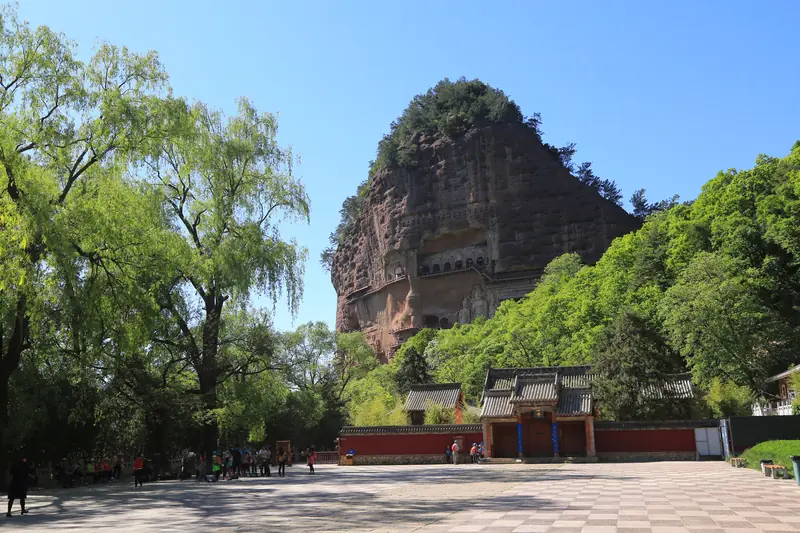
Of China's four great grottoes, Mogao is known for murals, Yungang for stone carvings, and Longmen for its cliff-face colossi — the Maijishan Grottoes (麦积山石窟) 📍 (Google | Amap) are all about clay. Over 10,000 painted clay sculptures cling to a 142-meter red sandstone pinnacle shaped like a haystack, connected by vertiginous cliffside walkways bolted to the rock face. The result is China's most intimate grotto experience — more three-dimensional, more alive with color, and far more physical than any of the other three.

What Makes Maijishan Different
Every figure here was built up by hand — layers of fine clay over a rough stone core, then finished with mineral-pigment paint. The technique produced softer expressions and more fluid drapery than stone carving ever could, and many sculptures still retain their original colors from 1,500 years ago. The Chinese call Maijishan the "Eastern Gallery of Sculpture" (东方雕塑陈列馆).
The first caves were cut during the Later Qin (后秦) dynasty (384–417 CE), and work continued through twelve successive dynasties. Today 221 caves survive — 194 on the two main cliffs (54 on the East Cliff and 140 on the West), the rest scattered around the mountain — holding over 10,000 individual sculptures and roughly 1,000 square meters of murals. In 2014, Maijishan was inscribed on the UNESCO World Heritage List as part of the "Silk Roads: the Routes Network of Chang'an–Tianshan Corridor."
Why Clay, Not Stone?
Maijishan's reddish-purple sandstone is far softer than the gray sandstone at Yungang — fine carving directly into it was virtually impossible. But the ancient artisans turned that limitation into an advantage. They chiseled a rough human outline into the rock face (a "stone skeleton"), then built up layers of fine clay mixed with straw and cotton fiber, finishing with mineral-pigment paint.

The process — called "stone-core clay sculpture" (石胎泥塑) — meant each figure could be shaped and reshaped before the clay set, giving artisans a freedom impossible with chisel and stone. That freedom shows: Maijishan's faces are among the most emotionally alive in all of Chinese Buddhist art.
A Thousand Years of Evolving Style
Spanning roughly 1,100 years of continuous work, the grottoes are a compressed visual history of Chinese Buddhist art:
- Early Northern Dynasties (Later Qin–Northern Wei, ~400–530 CE): Bold, heavy forms — square faces, high-bridged noses, simple robes — with clear Gandharan and Central Asian influence. This period accounts for roughly 70% of all caves and represents Maijishan's artistic peak.
- Late Northern Dynasties (Western Wei–Northern Zhou, ~530–580 CE): Figures begin to "Sinicize" — rounder faces, subtler expressions, flowing wide-sleeved robes replacing the tight-fitting Central Asian style. Cave 44's "Eastern Smile" was born in this era.
- Sui–Tang (580–907 CE): Figures grow fuller and more naturalistic, with proportions approaching real human anatomy and increasingly secular facial expressions — bodhisattvas start to look less like remote deities and more like real people. The East Cliff Great Buddha (15.7 m) is a Sui-era work.
- Song–Ming (960–1644 CE): Fully realistic — robes, jewelry, and hairstyles rendered with the precision of contemporary woodwork. Technical skill is high, but creative energy and scale diminish compared to the Northern Dynasties.

Getting to Maijishan
From Xi'an (Recommended)
High-speed rail is the easiest option. From Xi'an North Station (西安北站) 📍 (Google | Amap), take a bullet train to Tianshui South Station (天水南站) 📍 (Google | Amap) — about 1.5 hours, second-class seats typically ¥100–120 depending on the train and date. Multiple departures daily make a day trip entirely feasible. Check Trip.com or 12306 for current schedules and fares.
From Lanzhou
From Lanzhou West Station (兰州西站) 📍 (Google | Amap) to Tianshui South, about 1.5–2.5 hours by bullet train, second-class typically ¥60–140. A good option if you're coming from Xining or Dunhuang and making Tianshui a stop along your Gansu route.
From the Station to Maijishan
From Tianshui Railway Station (天水火车站, the old station) 📍 (Google | Amap):
- Bus 34 departs from the southeast corner bus stop, runs directly to Maijishan Scenic Area. About 60 minutes, ¥5, every 15 minutes.
From Tianshui South Station (the high-speed station):
- Take Bus 60 or connect via Bus 1, 9, 35, or 58 to the city center, then transfer to Bus 34. Total transit time roughly 1.5–2 hours.
- Taxi / ride-hailing: Direct to Maijishan, about 40 minutes, ¥80–100. If you're on a day trip and time is tight, this is your best bet.
Show this screen to your driver · 出示给司机看
请送我到麦积山石窟
Please take me to the Maijishan Grottoes.
From Tianshui South Station: ~40 min, ¥80–100. Or Bus 34 from old Tianshui Station — ¥5, ~60 min.
Getting Around the Scenic Area
The visitor center is about 3 km from the cave entrance — uphill the entire way.
- Shuttle bus (recommended): Round-trip ¥15, one-way ¥8. Operating hours follow the scenic area's daily schedule, typically around 8:30–18:00.
- Walk: 30–40 minutes uphill through the Maijishan Botanical Garden's shaded trail — gorgeous in autumn with red leaves — but after hours of cave climbing, the 3 km walk back gets tiring.
Best strategy: Shuttle up, walk down. Save your legs for the caves, then stroll the tree-lined path back and grab the classic "haystack" distance shot from the valley.

Tianshui South Station (天水南站) is your gateway — bullet trains from Xi'an arrive in about 90 minutes. From here, a taxi or Bus 34 will get you to the scenic area (see transport options above).
Tickets, Hours & Booking
Prices below are from the Maijishan Grand Scenic Area management committee's published ticketing guide. Check the 麦积山旅游 (Maijishan Tourism) WeChat Official Account or on-site announcements for the most current figures.
| Item | Details |
|---|---|
| Grotto full-price ticket | ¥80/person; half-price ¥40 (students, seniors, etc.) |
| Scenic area only (no caves) | ¥25/person |
| Shuttle bus | Round-trip ¥15, one-way ¥8 |
| Grotto + shuttle (combined) | ~¥95 full-price (80 + 15); ~¥55 half-price |
| Opening hours | Peak season roughly 8:30–17:30; off-season roughly 9:00–17:00 — ticket sales stop earlier (~16:00), confirm on-site |
Winter–spring discounts: The scenic area typically runs half-price or combo promotions for Xianren Cliff, Shimen, and other nearby sites. Whether the grotto's ¥80 base ticket itself gets a seasonal discount varies by year — check the WeChat Official Account rather than relying on third-party "off-season ¥50" claims.
How to buy:
- Online: Follow the "麦积山旅游," "麦积山石窟," or "天水智慧旅游" WeChat Official Accounts to reserve up to 30 days ahead. Real-name registration required; one ticket per ID per day.
- On-site: Walk-up windows available, but expect queues on peak-season weekends and holidays.
- Foreign visitors: Online booking usually requires a Chinese phone number. Without one, buy at the window with your passport.
- Entry verification: Chinese citizens scan ID + facial recognition. Foreign visitors use the manual passport lane — follow on-site signage.
Special caves (premium-protected caves on a separate route from the standard ticket):
- Pricing (per the management committee): Under 5 visitors: ¥400/session; 5–10 visitors: ¥600/session; over 10 visitors: ¥60/person — all include guided commentary. Set by the Maijishan Grottoes Art Research Institute (麦积山石窟艺术研究所).
- Whether they're open on a given day, which caves are included, and whether photography is allowed depend entirely on the Research Institute's current arrangements. Don't rely on outdated blog posts citing "¥100–180 per cave."
- See "Are Special Caves Worth the Extra Cost?" below.
Guided tours:
- Chinese guide: ¥50 (1–5 people), ¥70 (5–10), ¥110 (15+)
- English guide: from ¥50 (1–5 people)
Planning Your Visit
How Long to Spend
3 hours is the standard visit, covering the main walkways and open caves. If you want to add special caves, the Ruiying Monastery at the base, and the botanical garden trail, plan for 5 hours.
Recommended Route
The caves split between the East Cliff and West Cliff, stacked seven levels high. Follow this loop:
- West Cliff Upper(西崖上层)— Fewest visitors — Caves 133, 135, 127 in quiet
- West Cliff Lower(西崖下层)— Work down while legs are fresh; Cave 98 Great Buddha
- East Cliff Upper(东崖上层)— Cave 4 (Seven-Buddha Hall) and Cave 13 Great Buddha
- East Cliff Lower(东崖下层)⭐— Save Cave 44 Eastern Smile for the crescendo finish
Best Time to Arrive
- 8:30 at opening: Best light (morning sun hits the East Cliff face directly), fewest people, ideal for photography.
- After 14:00: Tour groups thin out and the walkways clear up. In winter, watch for early sunset.
Peak vs Off-Season
- Peak season (April–October): Comfortable weather, lush greenery on the mountain — but during Golden Week and summer holidays, the walkways get genuinely crowded. The narrowest sections fit only one person at a time, and queuing is unavoidable.
- Off-season (November–March): Sparse crowds, peaceful walkways. The grotto base ticket stays at ¥80; seasonal promotions on other scenic area sites may apply — check the WeChat Official Account. Snow and ice can close upper walkways for safety.
Weather & What to Wear
Tianshui sits at the western end of the Qinling Mountains, with a milder, more humid climate than Dunhuang or Datong. Maijishan itself is draped in dense vegetation — the most obvious visual contrast with China's other three great grottoes.
- Spring (March–May): Daytime 15–22°C, cool mornings and evenings. Bring a light jacket.
- Summer (June–August): Cool but rainy — expect wet walkways, especially July and August. Rain gear and non-slip shoes are essential.
- Autumn (September–November): The best season — pleasant temperatures, less rain, red and gold foliage across the mountain.
- Winter (December–February): Possible snow, some walkways closed. Wear warm, grippy shoes.
Cliff Walkway Safety
Maijishan's walkways are bolted directly to the cliff face, with the highest sections roughly 80 meters above the ground and the narrowest stretches fitting only one person. Some paths are steep with iron railings but no glass barriers. If you have a serious fear of heights, stick to the lower levels — you can still reach most star caves including Cave 44.

Despite the vertigo factor, the walkways reward every step — views sweep across the forested valley, and you're eye-level with sculpture details invisible from below. Arrive at opening for the thinnest crowds and the best morning light on the East Cliff face.
Must-See Caves: East and West Cliffs
The caves aren't laid out along a flat cliff face like Yungang — they're clustered like a massive honeycomb across both cliffs, rising in tiers up the rock. Below are the highlights, organized by the recommended route.
West Cliff — The Grand Halls
The West Cliff holds Maijishan's largest and finest cave clusters, including most of the premium-protected special caves.
Cave 133 (Hall of Ten Thousand Buddhas / 万佛洞) ★ Special cave

Located on the upper east section of the West Cliff, carved in the late Northern Wei period. This is Maijishan's largest and most content-rich cave — step inside and you're surrounded by a 3.5-meter welcoming Buddha and over 30 clay sculptures. The two most celebrated works here: the "Thousand-Buddha Stele," a single stone slab densely carved with hundreds of miniature Buddha figures; and a smiling young novice monk whose expression is so mischievous and natural it looks nothing like religious statuary — more like the kid next door. If the special cave route includes this one, it's typically the most worthwhile.
Cave 135 (Celestial Cave / 天堂洞) ★ Special cave
The tallest cave on either cliff, located on the upper east section of the West Cliff. Three "skylights" cut into the front wall let natural light pour in from above — in an era 1,500 years before electric lighting, this design was a stroke of genius. Inside you'll find Maijishan's largest single stone-carved figure (notably, not clay — one of the rare cases where artisans carved directly into the rock), along with well-preserved Nirvana-scene murals.
Cave 127 ★ Special cave
Sits at the very top of the West Cliff's western section — one of the highest accessible caves at Maijishan. It preserves the Northern Dynasties' largest narrative wall paintings, including the Nirvana scene and the "Eight Kings Contesting the Relics." The colors remain remarkably vivid; in the dim interior light, the visual impact is striking (whether supplemental flashlights are allowed depends on current on-site rules).
Cave 98 (West Cliff Great Buddha)

A 14-meter-tall, 10-meter-wide rock-core clay Buddha visible from the walkways far below. This is one of those sculptures best appreciated from a distance — up close, the viewing angle is too steep to take in the whole figure.
East Cliff — Home of the "Eastern Smile"
The East Cliff has fewer caves but concentrates some of the finest individual masterpieces. Cave 44 is the icon of the entire site.
Cave 44 — The "Eastern Smile"

If you remember only one work from Maijishan, this is the one. This Western Wei-era (roughly 535–556 CE) clay Buddha stands just 1.6 meters tall, yet it's widely regarded as the pinnacle of Northern Dynasties clay sculpture. The face is serene, the eyes slightly downcast, and the lips carry a faint, almost imperceptible smile — not joyful, not solemn, but something beyond both. It's often compared to the Mona Lisa. The difference: Leonardo used paint to create mystery; Maijishan's anonymous artisan used clay and bare hands to achieve the same thing, fifteen centuries ago.
Cave 4 (Seven-Buddha Hall / 七佛阁)

China's largest surviving palace-style cave — 31 meters wide, 8 meters deep, 16 meters tall, big enough to pass for a real Buddhist hall. Seven large Buddhas sit in a row inside, and the ceiling preserves Northern Zhou flying-apsara murals. Every structural detail — columns, beams, bracket sets — is carved in imitation of real palace architecture, making this cave invaluable for the study of Northern Dynasties building design.
Cave 13 (East Cliff Great Buddha)
The East Cliff's landmark — a 15.7-meter stone-core clay seated Buddha from the Sui dynasty. Full-bodied with a serene expression, it's a textbook example of Sui-era aesthetics. Viewed from the opposite hillside, the Great Buddha framed by layered walkways and the red cliff face is one of Maijishan's most photographed compositions.
Cave 43 (Tomb of Empress Yi Fu / 魏后墓)

Not an ordinary Buddhist cave — this was the burial cave of Empress Yi Fu (乙弗氏) of the Western Wei. In 540 CE, the empress was forced to take Buddhist vows here and later ordered to her death; her tomb was cut directly into the grotto cluster. The entrance features a three-bay, four-column cliff pavilion — Maijishan's earliest surviving cliff-gallery architecture. A royal burial embedded inside a Buddhist cave complex: this kind of hybrid political-religious space is exceedingly rare in Chinese grotto art.
Are Special Caves Worth the Extra Cost?
Special cave routes follow a separate path from the standard ticket and require additional payment with a dedicated guide (see pricing in "Tickets, Hours & Booking" above). Which routes are available, how many caves each includes, and whether photography is allowed depend on the Research Institute's arrangements that day.
Art priority (for reference): Cave 133 (Hall of Ten Thousand Buddhas) > Cave 135 (Celestial Cave) > Cave 127 (narrative murals). If only one route is available, ask staff which caves it covers.
Best for: Groups who can split the session fee; travelers with genuine interest in Buddhist art and art history who have time to spare.
Skip if: Solo and budget-conscious, or racing to catch a return train — the standard open caves are already excellent.
How to arrange: Upon arrival, ask at the Maijishan Grottoes Art Research Institute (麦积山石窟艺术研究所) desk or the scenic area service counter about current availability — policies are occasionally adjusted, so always confirm on the day of your visit.
What Most Tourists Miss
"Whispering" — Cave 121

Visitors rushing along the walkways often pass right by this small cave. Inside are two Northern Wei painted-clay bodhisattvas in a striking pose: heads tilted toward each other, one leaning slightly forward, the other appearing to listen — as if sharing a secret. In a grotto complex filled with solemn Buddhas, this kind of warmly human, almost gossipy gesture is extraordinarily rare. You can sense that the artisan, fifteen hundred years ago, smuggled a little slice of everyday life into sacred art.
"Steppe Meets Silk Road" — Cave 123
Right next to Cave 121. Flanking the entrance are a pair of child attendant clay figures — a boy and a girl wearing distinctly Central Asian-style clothing, with lively expressions and natural, unstiff postures. Scholars call this pairing a snapshot of "steppe meets Silk Road" — East and West cultural fusion distilled into a child's form.
Cave 78 — The Oldest Time Capsule
One of Maijishan's earliest caves (roughly Later Qin period), preserving the raw, "first-draft" style of Buddhism's initial arrival in China. The figures are rough, the compositions simple, with a noticeable "translation accent" — you can tell the artisans were copying templates brought from the Western Regions but hadn't yet fully absorbed them. For art history enthusiasts, this "imperfection" is precisely what makes it priceless.
Ruiying Monastery at the Base

Most visitors head straight for the cliff walkways and completely skip Ruiying Monastery (瑞应寺) 📍 (Google | Amap) at the mountain's foot — a temple first built in the Later Qin era, with its current buildings in Ming–Qing style. It's included in the grotto ticket at no extra charge. Ancient trees over a thousand years old shade the quiet courtyard. A twenty-minute loop after descending from the caves is all you need.
The "Haystack" Long Shot & Botanical Garden Trail
Here's something you won't see at Mogao or Yungang: the entire mountain is draped in dense green forest — lush, almost subtropical. Looking back from the shuttle drop-off point, you see the full "haystack" profile — the cliff face with its honeycomb of walkways and cave mouths, half-hidden among trees. This angle is the classic long-distance composition, especially spectacular in autumn when red leaves frame the red sandstone.
Where to Eat in Tianshui
A few noodle stalls and simple restaurants cluster at the scenic area entrance — mostly noodles and quick meals, around ¥10–15. If time allows, Tianshui proper is worth a food detour — it's one of Gansu's most culinarily rich cities.
Tianshui Specialties
- 呱呱 — Tianshui's signature snack. Buckwheat starch set into jelly-like blocks, cut into irregular chunks, and tossed with chili oil, sesame paste, vinegar, and garlic. Smooth, bouncy, mildly spicy and tangy. Locals eat it for breakfast. ¥5–8 per serving.
- 浆水面 — Fermented vegetable broth (similar to sour-cabbage soup) over hand-pulled noodles. Light, tangy, and refreshing — Tianshui's everyday staple, especially good in summer. ¥8–12 per bowl.
- 天水麻辣烫 — Nothing like the northeastern Chinese version. Tianshui-style is a pot of rich beef-bone chili broth where you pick your own skewered vegetables and meats to cook tableside. Heavy on the numbing málà heat — on a winter day, one pot warms you to the bone. ¥15–25 per serving.
| English | Chinese | Pinyin | Say It Like… |
|---|---|---|---|
| Buckwheat jelly snack | 呱呱 | guāguā | Gwah-gwah |
| Fermented vegetable noodles | 浆水面 | jiāngshuǐ miàn | Jee-ahng-shway mee-en |
| Spicy numbing hotpot | 麻辣烫 | málàtàng | Mah-lah-tahng |
Where to Find It
- At the scenic area entrance: Quick noodles for lunch — convenient but limited choices.
- Fuxi Road (伏羲路) and Dazhong Road (大众路) in Tianshui city center — the local food-crawl zone, lined with small shops, breakfast stalls, and night market vendors.
- Near Tianshui South Station: A handful of quick-service restaurants, fine for a bite before catching your train.


Combine with Other Tianshui Sights
Maijishan takes half a day to a full day, but Tianshui itself rewards an extra half-day or an overnight stay.
Xianren Cliff

Xianren Cliff (仙人崖) 📍 (Google | Amap) falls under the same Maijishan Grand Scenic Area administration but is a separately ticketed site (full-price ~¥40, shuttle extra), about 15 minutes by car from Maijishan. A cluster of Taoist cliff-face temples makes an interesting contrast to the Buddhist grottoes. Winter–spring promotions sometimes include half-price entry — check the WeChat Official Account for current pricing.
Fuxi Temple
Fuxi Temple (伏羲庙) 📍 (Google | Amap) sits in Tianshui's city center — one of China's largest surviving memorial complexes dedicated to Fuxi (伏羲), the legendary progenitor of Chinese civilization. The well-preserved Ming-dynasty compound is shaded by ancient cypresses. Full-price ticket is typically around ¥40 (confirm on-site). About 30 minutes by public bus from Tianshui South Station.
Suggested Itineraries
Day trip from Xi'an:
- Xi'an North Station(西安北站)— Early bullet train to Tianshui South (~90 min)
- Taxi to Maijishan(打车到麦积山)— ~40 min from Tianshui South, ¥80–100
- Maijishan Grottoes(麦积山石窟)⭐— Morning through midday (~3 hrs standard route)
- Lunch at Scenic Area(景区门口午餐)— Quick noodles or local snacks, ¥10–15
- Fuxi Temple or City Food(伏羲庙 / 市区美食)— Afternoon exploration in Tianshui center
- Evening Train Back(晚班高铁返回)— Check Trip.com or 12306 for return schedules
Two-day deep dive:
Day 1: Arrive in Tianshui, afternoon at the Maijishan Grottoes (including 1–2 special cave routes), evening back in the city for Tianshui street food.
Day 2: Morning at Xianren Cliff or Fuxi Temple, afternoon departure — or continue west toward Lanzhou.
FAQ
Yes — the lower-level walkways are more comfortable and still give you access to most star caves, including Cave 44 ('Eastern Smile') and Cave 4 (Seven-Buddha Hall). Skip the upper walkways if you can't handle the exposure.
Beyond This Guide
Maijishan fits naturally into a Silk Road itinerary or an extended Xi'an–Gansu trip — but piecing together train schedules, special cave logistics, and Tianshui's best food stops takes local know-how. Our planners design day-by-day routes tailored to your pace and interests.
Tell us your dates and interests — we'll turn them into a day-by-day plan you can actually follow.
Start PlanningFree initial consultation · No commitment
Maijishan is one of China's four great grottoes. For the others, see our Mogao Caves guide (Dunhuang, murals) and Yungang Grottoes guide (Datong, stone carvings). If you're arriving via Xi'an, the Terracotta Warriors and Xi'an City Wall are easy to combine.
Planning a trip to Tianshui? See our complete Tianshui guide →
You Might Also Like

The Forbidden City: Complete Visitor's Guide to Beijing
Complete guide to China's Forbidden City — advance tickets, three official routes, top halls, hidden secrets, food and transport for independent travelers.

Terracotta Warriors: Complete Visitor's Guide to Xi'an
Complete guide to Xi'an's Terracotta Warriors — advance tickets for foreign passports, two-zone routing strategy, deep dives on all three pits, Bronze Chariots, and transport from the city.
Leshan Giant Buddha: Complete Visitor's Guide
Complete guide to the Leshan Giant Buddha — tickets, Nine-Bend Plank Road, boat tour, hidden drainage system, Leshan food, and how to visit from Chengdu.
Temple of Heaven: Complete Visitor's Guide to Beijing
Complete guide to Beijing's Temple of Heaven — tickets, walking routes, acoustic secrets, morning park life, and hidden gems for independent travelers.
Need Help Planning Your Tianshui Trip?
Turn these sights into a real, day-by-day itinerary — we'll handle the logistics so you can focus on the experience.
Personalised Sightseeing Plan
We match attractions, timings, and hidden spots to your travel style and pace.
Full Day-by-Day Itinerary
Every day mapped out — transport between sights, skip-the-queue tips, and backup options.
On-Trip Support
Need a last-minute recommendation or detour? We're on WhatsApp throughout your trip.
See How We Can Help
Free initial consultation · No commitment