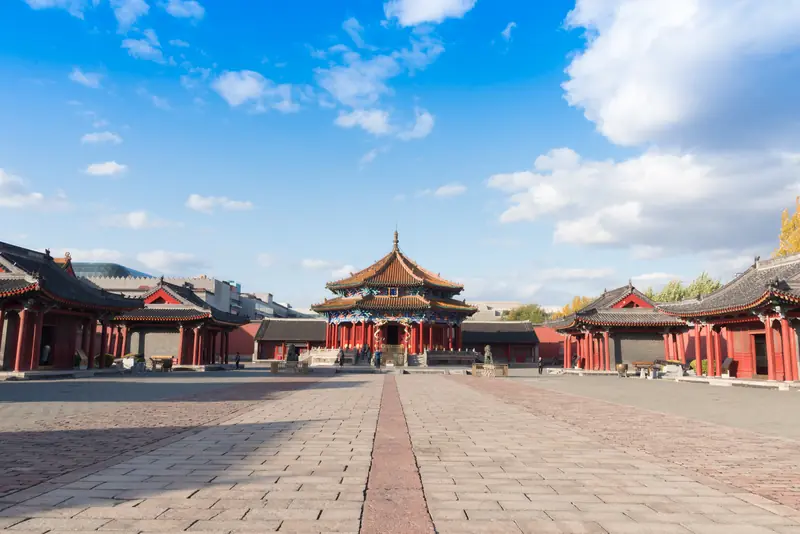
Shenyang Imperial Palace: Complete Visitor's Guide
Visitor's guide to Shenyang Imperial Palace (Mukden Palace) — UNESCO site, Manchu architecture, ¥50 tickets, 2–3 hour route, and tips most tourists miss.
~12 min readUpdated Mar 2026
🏛️ China's 2nd Imperial Palace
🎟️ No Advance Booking
🌍 UNESCO World Heritage
🏮 Qing Dynasty Birthplace
Hours & Tickets
PeakApr 10 – Oct 10
8:30 – 17:00Off-peakOct 11 – Apr 9
9:00 – 16:30¥50 adult¥25 concessionFree under 6 / 70+
⏰
Last entry: 16:15 peak / 15:45 off-peak
📅
Closed Mondays (except holidays & Jul–Aug)
🕐
Budget 2–3 hours for all three zones
Good to know
🚇
Metro Line 1 to Zhongjie Station (中街站), Exit C — walk west along the pedestrian street 5–10 minutes to the south gate.
🎧
English audio guide available at the south gate (~¥40 deposit, refunded). Main halls have bilingual panels. Staff speak limited English — keep a translation app handy.
📷
Photos: Courtyards and open halls are fine; obey no-photography signs on display cases. Tripods need prior permission.
China has two surviving imperial palace complexes. The Shenyang Imperial Palace (沈阳故宫博物院), also known as Mukden Palace, is the lesser-known one — and on a good morning you can stand alone in front of its octagonal throne hall, a privilege Beijing's palace no longer offers.
What Is Mukden Palace?

The Shenyang Imperial Palace is one of only two complete imperial palace complexes surviving in China — the other being Beijing's Forbidden City. The two are not copies of each other. Beijing's palace is the pinnacle of Han Chinese imperial ideology: perfectly symmetrical, relentlessly axial, built to awe through sheer scale. Shenyang's palace was built by a different people at a different moment in history — and its architecture shows it.
Construction began in 1625 when Nurhaci moved his capital to Shenyang. After his death, his son Hong Taiji continued building and in 1636 proclaimed the Qing Dynasty here, changing the dynasty's name from Later Jin and setting the stage for the conquest of China eight years later. The palace blends Manchu, Han Chinese, Mongolian, and Tibetan architectural traditions within a single compound — a cultural layering found nowhere else in Chinese palace architecture.
60,000 m²
Palace Area
500+
Rooms
114
Buildings
2004
UNESCO Listed
Shenyang's visitor numbers are far lower than Beijing's — even on busy weekends, the main halls rarely feel crowded and ticket queues seldom exceed fifteen minutes.
Already visited the Beijing Forbidden City?
Shenyang is still worth the trip. The architecture, historical context, and cultural DNA are genuinely different — it is not a repeat experience. If time allows only one imperial palace, Beijing offers greater scale. But if you have an interest in early Qing history or Manchu culture, Shenyang is irreplaceable.
Shenyang vs. Beijing's Forbidden City
Most visitors ask: "I've already been to Beijing — what's different here?" The answer is: almost everything that matters.
| Shenyang Imperial Palace | Beijing Forbidden City | |
|---|---|---|
| Area | 60,000 m² | 720,000 m² |
| Buildings | 114 buildings, 500+ rooms | 980 buildings, 9,371 rooms |
| Adult ticket | ¥50 | ¥60 peak / ¥40 off-peak |
| Booking | Walk-in, no reservation | 7 days advance (peak season) |
| Crowds | Low to moderate | Very high (peak season) |
| Visit duration | 2–3 hours | 3–5 hours |
| Architectural style | Manchu + Han + Mongol + Tibetan | Han Chinese imperial |
| UNESCO listed | 2004 (as an extension) | 1987 |
Scale and crowds. Beijing averages close to 40,000 visitors per day at peak. Shenyang receives a fraction of that. In Beijing, the square in front of the Hall of Supreme Harmony fills wall-to-wall with tour groups during Golden Week; in Shenyang, you can usually find a quiet spot to study the architecture without anyone blocking your view.
Architectural logic. Beijing's spatial logic is a single northward axis — a sequence of gates and courts designed to compress and release, building psychological pressure toward the throne. Shenyang is structured differently: three functionally distinct zones built across different eras, each telling a different chapter of history. You are not walking a straight line; you are reading three parallel stories.
Historical density. Beijing's palace witnessed five hundred years of Ming and Qing imperial history. Shenyang's window is narrower — roughly 1625 to 1644 when the Qing armies moved south — but these twenty years were among the most consequential in Chinese history. Every architectural decision in Shenyang encodes that transition from tribal confederacy to empire.
Three Architectural Zones
The Shenyang Imperial Palace divides into three sections with different functions, construction periods, and design vocabularies. Understanding each zone's logic transforms a walk-through into a coherent historical experience.
Eastern Section: Manchu Military Origins
~30 min
Visit time
1625
Built by Nurhaci
11
Pavilions
🔑
Must-see
The eastern section is the most architecturally distinctive part of the palace — and the first thing most visitors see after entering the south gate.
Hall of State Affairs (大政殿) 📍 (Google | Amap)

The Hall of State Affairs is the only surviving octagonal throne hall in any Chinese imperial palace — nothing like it exists in Beijing. The eight-sided plan derives from the Manchu tradition of circular military campaign tents: a nomadic spatial form translated into permanent stone and timber. The roof is tiled in yellow and green glazed ware; the columns are painted with Han-style scroll patterns, Tibetan Buddhist motifs, and coiling dragons. Look up at the eaves and you can read three civilizations at once.
This is where Hong Taiji ascended the throne in 1636 and declared the founding of the Qing Dynasty. Standing inside today, facing the throne dais, the room is noticeably more intimate than Beijing's Hall of Supreme Harmony — but its historical weight is comparable.
Ten Kings Pavilions (十王亭)

Ten smaller pavilion-style structures — five on each side — flank the Hall of State Affairs in a broad open formation. This arrangement, unique among all surviving Chinese palaces, was not decorative: each pavilion was a working administrative office for the commanders of the Eight Banners, the military and civil organization through which Nurhaci governed his confederation.
The spatial logic directly reflects the early Qing power structure: Nurhaci's rule was not absolute monarchical authority but a form of collective governance among banner lords and royal kinsmen. After the Qing conquest of Beijing, this collective model was gradually replaced by centralized imperial rule — and the Ten Kings Pavilions became the only surviving physical evidence of that transitional political experiment.
Central Section: Imperial Power in Practice
~45 min
Visit time
1627–1636
Built
3
Key halls
📸
Best overview
The central section is the administrative and residential heart of the palace, built in stages by both Nurhaci and Hong Taiji. Its structure most closely resembles the layout of a traditional Han Chinese palace, but the details consistently reveal Manchu cultural presence.
Chongzheng Hall (崇政殿)

Chongzheng Hall was Hong Taiji's daily audience chamber — roughly equivalent in function to Beijing's Hall of Preserving Harmony. The exterior features a green glazed roof rather than the imperial yellow of Beijing, reflecting a transitional period when Manchu rulers had not yet fully absorbed Han chromatic symbolism. The throne inside is an early Qing form, plainer than the gilded seats of the Beijing palace.
Above the entrance, inscriptions appear in both Manchu script and Chinese characters — a bilingual display that was gradually phased out after the Qing court moved to Beijing, where Han Chinese visual language eventually dominated. Shenyang preserves a document of the in-between.
Phoenix Tower (凤凰楼)

Phoenix Tower is the tallest structure in the central section — three stories on a raised platform — and for several centuries it was the highest building in the entire city of Shenyang. Climbing to the top provides the clearest overview of the three-zone layout: eastern section to the left rear, western section to the right, central axis directly below. The interior now houses an exhibition of early Qing ritual objects, costumes, and documents.
Qingning Palace (清宁宫) and the Shamanistic Chimney
Qingning Palace was Hong Taiji's residential quarters, positioned behind Phoenix Tower. From the outside it resembles a standard Han imperial residential hall — but look at the main ridgeline of the roof. A slender pole stands upright from the ridge: this is a suo'er'gan (索伦杆), a Shamanistic ritual pole used in Manchu ceremonies to communicate with heaven. Nothing equivalent exists anywhere in the Beijing Forbidden City — where Shamanistic practice was systematically confined to a rear courtyard and eventually replaced by Han court ceremony.
Don't miss the roof of Qingning Palace
Stand in the courtyard and look up at the main roof ridge — the suo'er'gan is a thin upright pole rising from the center. It's easy to walk past, but once you see it, every other imperial palace in China feels incomplete.
Western Section: Qianlong's Cultural Legacy
~30 min
Visit time
1782
Completed
2
Main buildings
📚
Library + Theater
The western section was the last to be built (completed 1782), commissioned by the Qianlong Emperor as a cultural addition to the ancestral palace. Its style is noticeably more elaborate and Han-influenced than the eastern and central zones — the aesthetic of a mature empire looking back at its origins.
Wensu Pavilion (文溯阁)

Wensu Pavilion was built to house one of the seven original copies of the Complete Collection of Four Treasures (四库全书), an imperially commissioned encyclopedic collection of over 36,000 volumes. Of the seven storage buildings, four survive as structures; Wensu Pavilion is one of them.
The building was designed on the principle of water overcoming fire — a protective philosophy applied to library architecture. The roof is tiled in black glazed ware, rare in Ming-Qing imperial buildings, and the interior timbers are painted blue-green: the colors of water. Qianlong used these buildings to position the Qing as the orthodox inheritors of Chinese literary civilization.
Note: The actual Wensu Pavilion copy of the Four Treasures is no longer in the building. After a series of wartime relocations across northeast China, it was transferred to Gansu in 1966 and is now housed in a purpose-built archive on Jiuzhoutai (九州台) hill in Lanzhou. What you see inside today are reproduction volumes and furniture, restoring the historical appearance of the reading rooms.
Geyinyuan Stage and Jiayindang Hall
Adjacent to Wensu Pavilion, a Qing-dynasty theater stage survives — built for imperial use during the Qing emperors' periodic return visits to the ancestral capital for tomb-veneration ceremonies. The stage is now empty but structurally intact, with carved brackets and painted rafters more ornate than the rest of the western section.
Suggested Route Through the Palace
The palace has no required visiting sequence, but the three-zone layout rewards a logical order. The route below takes 2–3 hours at a comfortable pace.
- Eastern Section(东路·大政殿)⭐— 30 min · Octagonal throne hall + Ten Kings Pavilions
- Central Section(中路·崇政殿→凤凰楼→清宁宫)— 45 min · Main axis: audience hall, tower view, shamanic pole
- Western Section(西路·文溯阁)— 30 min · Black-tiled library + Qing theater stage
- Museum Galleries(展厅)— 15–30 min · Optional: costumes, ritual objects, documents
- Exit & Lunch(中街)— South or north gate → 3 min walk to Zhongjie pedestrian street

Hidden Details Most Tourists Miss
Walking through quickly is easy. Noticing what makes this palace architecturally different from every other site in China requires knowing where to look.

Five things worth finding on your walk — screenshot this list before you enter.
① Roof creatures on Dazheng Hall — Beijing's Hall of Supreme Harmony carries eleven mythical ridge animals. Shenyang carries fewer, in a different configuration — reflecting incomplete adoption of Han ritual hierarchy. Also note the globular finials: a Manchu convention absent from Beijing.
② Which pavilion, which banner — The two closest to the Hall of State Affairs (east side) belonged to the directly imperial banners — Plain Yellow and Bordered Yellow. Current signage identifies each pavilion's original assignment; tracing the layout reveals early Qing political hierarchy.
③ Three-zone boundary from Phoenix Tower — The tower's top floor provides the clearest aerial view. Each zone — enclosed by its own walls and gates — reads as three distinct administrative worlds sharing a perimeter.
④ Shamanic pole on Qingning Palace's roof — Stand in the courtyard behind Phoenix Tower and look up at the main ridge. The thin upright pole is easy to miss at a glance.
⑤ Why Wensu Pavilion's roof is black — Against the predominantly yellow and green tilework elsewhere, the black glazed tiles are impossible to miss once you reach the western section. The reason is explained inside.
Tickets, Hours & Entry Rules
Ticket prices
| Category | Price |
|---|---|
| Adult | ¥50 |
| Concession (ages 6–18 / students / ages 60–69) | ¥25 |
| Free (under 6 or under 1.3 m / ages 70+ / disabled / active military) | Free |
The base ticket covers all three zones and all open halls. Temporary exhibitions may carry a separate charge; staff will inform you at the entrance. Audio guides (Chinese and English) are available at the south gate ticket office for approximately ¥40 deposit (refunded on return).
Opening hours
| Season | Hours | Last entry |
|---|---|---|
| Peak (Apr 10 – Oct 10) | 8:30 – 17:00 | 16:15 |
| Off-peak (Oct 11 – Apr 9) | 9:00 – 16:30 | 15:45 |
Closed: Every Monday, except national public holidays and July–August (when the palace opens seven days a week). Verify the latest schedule at the official WeChat account 沈阳故宫博物院 before visiting; holiday hours occasionally differ.
How to buy tickets. No advance booking is required. Purchase at the south gate ticket windows on arrival. On-site payment accepts cash, WeChat Pay, and Alipay. A WeChat mini-program also allows purchasing e-tickets in advance — same price as the counter.
Best time to visit
Arrive at 8:30 when the gates open. The eastern section's Hall of State Affairs faces east, so the morning light angles across the octagonal hall at its best. Crowds are thin before 10:00. Avoid 11:00–14:00 on weekends — the busiest window of the week.
Winter visits. Shenyang winters (December–February) regularly drop to −15°C to −20°C. Some interior exhibition halls may close for heating maintenance. Snow-covered courtyards and the Ten Kings Pavilions in winter stillness have a particular atmosphere that attracts photographers willing to layer up.
How to Get to Shenyang Imperial Palace
The palace is at 171 Shenyang Road (沈阳路), Shenhe District (沈河区), in the center of Shenyang's old city.
| Method | Details | Time to south gate |
|---|---|---|
| Metro (recommended) | Line 1 → Zhongjie Station (中街站), Exit C | ~5 min walk west along pedestrian street |
| Bus | Routes 213, 222 → Gugong (故宫) stop | ~2 min walk |
| Taxi from Shenyang North Station | ~¥15–20 | 10–15 min |
Line 1 connects directly to Shenyang North Station (沈阳北站, the main high-speed rail hub) in about 15 minutes. For buses, use Gaode Maps (高德地图) or Baidu Maps for routing from your hotel.
Show this screen to your driver · 出示给司机看
请送我去沈阳故宫南门,沈阳路171号。
Please take me to the Shenyang Imperial Palace south gate, 171 Shenyang Road.
South gate (南门) is the main entrance with ticket windows. North gate (北门) also open — no enforced one-way flow.
Combine With Shenyang's Other Historic Sites
The Shenyang Imperial Palace sits at the center of a compact historic district. Within a 2-kilometer radius are Shenyang's other major historical landmarks, making half-day or full-day combinations easy.
Official residence of warlord Zhang Zuolin (张作霖) and his son Zhang Xueliang (张学良). Qing courtyards, Western reception halls, and Japanese gardens — Manchuria's contested 20th-century politics in one compound. 1.5 km · ¥48 · 1.5–2 hrs
Shenyang's oldest commercial street, right outside the palace south gate. Old-brand restaurants (老边饺子, 杨家吊炉饼) and modern shops — the most convenient lunch spot after the palace. Adjacent · 3 min walk · Free
Tomb of Hong Taiji and Empress Xiaoduan Wen (孝端文皇后) — the largest Qing imperial mausoleum in Shenyang, jointly UNESCO-listed. Palace + mausoleum = a full-day itinerary. 8 km north · Metro Line 2 · 20 min
Frequently Asked Questions
Yes, the main halls have bilingual Chinese-English explanatory panels, sufficient for self-guided visits. English audio guides are available for rent at the south gate ticket office (approximately ¥40 deposit, refunded on return). On-site staff have limited English; a translation app is useful for detailed questions. The palace's own WeChat mini-program includes a basic audio tour.
Beyond This Guide
The palace is one piece of Shenyang — a city with Qing imperial tombs, Republican-era mansions, and a food culture (老边饺子, 鸡架 deep-fried chicken racks) quite different from anything in southern China. Whether you have an afternoon to spare or are building a full Northeast China itinerary, we can help you design a plan that makes the most of your time in the region.
Tell us your dates and interests — we'll turn them into a day-by-day plan you can actually follow.
Start PlanningFree initial consultation · No commitment
Also in Shenyang and Northeast China: Shenyang Destinations Hub · The Forbidden City, Beijing
Planning a trip to Shenyang? See our complete Shenyang guide →
You Might Also Like

The Forbidden City: Complete Visitor's Guide to Beijing
Complete guide to China's Forbidden City — advance tickets, three official routes, top halls, hidden secrets, food and transport for independent travelers.

Terracotta Warriors: Complete Visitor's Guide to Xi'an
Complete guide to Xi'an's Terracotta Warriors — advance tickets for foreign passports, two-zone routing strategy, deep dives on all three pits, Bronze Chariots, and transport from the city.
Leshan Giant Buddha: Complete Visitor's Guide
Complete guide to the Leshan Giant Buddha — tickets, Nine-Bend Plank Road, boat tour, hidden drainage system, Leshan food, and how to visit from Chengdu.
Temple of Heaven: Complete Visitor's Guide to Beijing
Complete guide to Beijing's Temple of Heaven — tickets, walking routes, acoustic secrets, morning park life, and hidden gems for independent travelers.
Need Help Planning Your Shenyang Trip?
Turn these sights into a real, day-by-day itinerary — we'll handle the logistics so you can focus on the experience.
Personalised Sightseeing Plan
We match attractions, timings, and hidden spots to your travel style and pace.
Full Day-by-Day Itinerary
Every day mapped out — transport between sights, skip-the-queue tips, and backup options.
On-Trip Support
Need a last-minute recommendation or detour? We're on WhatsApp throughout your trip.
See How We Can Help
Free initial consultation · No commitment